“WE REALISED THAT THE IDEA OF IMMORTALISING ALL HIS REMAINING WORK WITH US COULD BE LIKE OUR PERSONAL FAREWELL AND ULTIMATE TRIBUTE TO TIMO’S LEGACY” – NSK (TEITANBLOOD)
Across, beyond two death-obsessed decades, enigmatic Iberian abstractionists Teitanblood have ceremonially crafted the cruellest, most immersive compendium of Black / Death Metal mania known to man. A towering tribute to sadly departed but forever immortalised erstwhile co-conspirator Timo Ketola, gloriously triumphant, grave-transcending fourth full-length ‘From the Visceral Abyss’ manifests a monumental and enduring emanation from the withered arteries of black earth; a crude conjoinment of contorted anatomy and twisted architecture; an obscure assemblage of musical mayhem and ocular horror. Could these dark reflections in the black waters of Death represent chief celebrant NSK’s most intimate and personal abomination under this blood-awashed banner? You have been sentenced. Death stands behind you. Have you heard the word from the visceral abyss?
 We are caught in a never-ending, cyclical trap. In its final throes, ‘From the Visceral Abyss’ segues ominously ouroboros-like back to a time and place before the genesis of ‘Seven Chalices’. As a consequence, your foul creations could now be perceived as being without beginning nor end. Are you ceremonially closing / completing the circle (allowing the recurring abominable, all-consuming darkness summoned by Teitanblood to reign everlastingly)?
“Not at all, how could I kill something that was forever dead?”
Teitanblood presents a multifaceted art form that assaults both the auditory and optical senses, with accompanying artwork / imagery as critical to the overall experience as the music itself. Must one immerse oneself in both the visual and audio creations to grasp the underlying message(s) or intent? And – notwithstanding how tricky and painstaking the musical composition alone must be – how time-consuming and potentially maddening is the task of aligning these two abstract elements to accurately reflect and communicate your full vision?
“In the band we all come from an already old generation that used to listen to albums end to end, going through the lyrics, scrutinising the cover, the credits, the thanks list and even the band shirts that the members were wearing. That’s how our experience has been shaped, and therefore, how each of our albums has been envisioned, so people can delve into its multiple layers, finding out new elements iteratively, and not as random songs that could fit into a Spotify playlist. However, as an author, I don’t think I should provide a guide on how to interpret or even consume our releases.
“The most maddening aspect in the creative process for me has always been to get lost in the black hole of addressing all the available variables to develop songs until they resonate and slowly embody the vision I want to display. Still, this process is one of the most rewarding parts of the creative journey and the amount of time and energy consumed becomes irrelevant at the end of it.”
Timo’s vast contribution to and influence upon Teitanblood is immeasurable and, even though ‘From the Visceral Abyss’ is the first full-length not adorned (at least directly) by his artwork, his spirit haunts and guides this record from beyond the grave (‘envisioned and revealed in strange aeons by T.Ketola and NSK’). I understand you drew lyrical inspiration from his body of work and legacy? Are Timo’s visions channelled and commemorated through every facet of the album (i.e., the central theme or concept, the music itself, and also the monolithic bloodstained art fashioned by Dávid Glomba)?
“After ‘The Baneful Choir’, my focus in Teitanblood was put on hold as my creativity had expanded into a different genre and, when Timo passed during the pandemic, the idea of leaving the band to rest seemed like it would make most sense.
“Due to the draconic restrictions and curfew in Spain during those days, it took more than a year until J, TTB drummer, and myself could meet in person again to discuss the ending of the band. However, while we referred to Timo’s entire influence, we realised that the idea of immortalising all his remaining work with us could be like our personal farewell and ultimate tribute to Timo’s legacy. Ironically, ‘From the Visceral Abyss’ became the album with more references and ideas from Ketola than any other – by far – as it was conceived solely as a tribute to the remaining ideas, unfinished conversations and initially sketched concept art.”
Albeit with the obvious caveat that such a cruel and punishing art form is only ever going to appeal to a limited audience, with your legacy secured – through consistency, sincerity, ferocity and quality – as undisputed standard-bearers of this belligerent black-death bastardisation and having crafted some of the most evil-saturated and genuinely unsettling recordings of all time, when you look back at your creations and accomplishments under the Teitanblood banner, and the reaction to them, what are your thoughts or feelings?
“I rarely look back at the past in life. I find it a waste of time and a temptation to procrastinate in nostalgia. I have a sense of accomplishment for satisfying the artistic urge of all these years, and I’m also humbled, despite my scepticism, by anyone being moved by what we did. As a music fanatic myself, I understand its impact and importance, so I’ve learned how to respect that and be grateful when receiving any recognition from someone else.”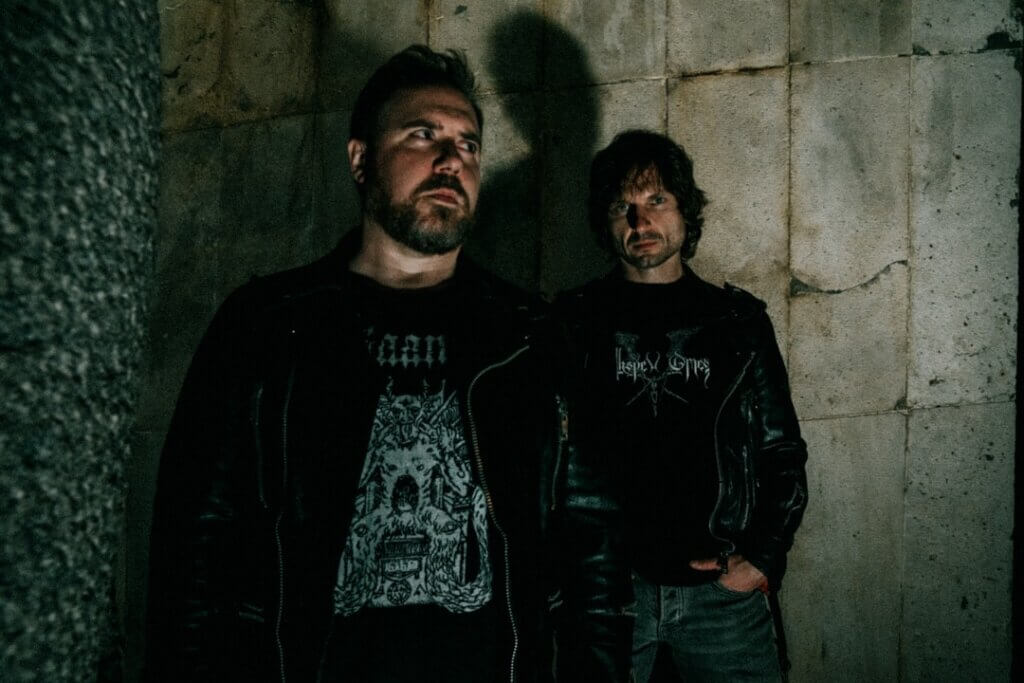 Teitanblood could be perceived as music by fanatics for fanatics. Your absolute obsession with this style of music is infectious and bleeds through the savage sounds and sinister sights of each release. Beyond striving to perfect the most potent representation of Black / Death Metal possible, did you at any point have any plan mapped out as to how the journey through catacombs of death should begin and end, or did Teitanblood as it grew and evolved ultimately take on a life – and hence also a death – of its own?
“Thank you – music by fanatics for fanatics is a very fitting description. In direct response to your question: yes, I did map our journey, but I always failed in all my predictions because, after each full-length, I was truly convinced that it would be the very last one. Then, most probably the obsession that you refer to has been responsible for entering again into a tunnel-vision trance with an idea that just sinked and evolved so monstrously that it became another conceptual full-length, and even leaving leftovers and unused materials.”
Well I guess art – like life itself – is the stuff that happens while we’re busy making plans! Were this to be the final tombstone of Teitanblood, as feared, then it is a fittingly monolithic, powerful and poignant one as ‘From the Visceral Abyss’ captures the essence of much of what makes this death-obsessed entity so compelling and inimitable: ominous melodies and eerie unsettling soundscapes merged chimerically with a tormentuous torrent of unbearable swirling violence, an orgy of riffs and wild solos, a sinister symphony of possessed tongues, pulverising drums hammering coffin nails relentlessly but methodically, fascinating lyrics, intoxicating imagery. Is this the ultimate statement / distilment of what Teitanblood represents?
“A crude simple skeleton frame border edges around a black empty black hole, that’s what the album IS. Such distilment has been everpresent across everything that we’ve done, and embodied differently across all our releases. You don’t fight the same as a young, wild grappler that is more explosive and swift as a veteran, strong-gripped, heavy one, who economises movement, and makes more mindful moves. I was in my late 20s when I started writing ‘Seven Chalices’, and ‘From the Visceral Abyss’ has been written 20 years later.
“Take that from my own linear optic as an author, but then, there are multiple scenarios around how our statement, as you call it, has been experienced: the first ones I can think of are the audiences that followed us since the demo, and have kept adopting every release in awe, while others got disappointed at some point in our career. Moreover it’s quite interesting to think how that experience may have been perceived for those who have listened to our albums and watched our artworks in a non chronological way… does the core of our statement stay as solid if your first encounter with Teitanblood is with ‘From the Visceral Abyss’? In that context, what does the ending of the album tell you if this is the first album that you hear?”
History will irrespectively document this record as a monolithic release in a dying underground … maybe the last of its kind. Teitanblood could not have existed without a deep obsession for the underground that spawned you. But times have changed and the underground is no longer what it once was. Do you feel the same passion and dedication for Black / Death Metal as you did setting out on this journey? Is there anything left there to inspire or influence you?
“Yes, I really have an extensive amount of written thoughts, ideas and music, in different styles and forms. I keep listening to new bands and releases that inspire me and connect with the same fires of old, while a network of fellow artists and friends – whose contact contributes to seeing the world around our monuments – continue to be a huge source of motivation, so I don’t see myself leaving this journey voluntarily, no matter how I try.”
 A year on from its blasphemous birth, ‘From the Visceral Abyss’ remains a compelling and intriguing enigma, the relentless march of death dominant and irresistible from the ominous, apocalyptic purge of ‘Enter the Hypogeum’ through to the parting divination of a deluded fraud in the utterly immersive and hypnotic masterstroke of orthodoxy, ‘Tomb Corpse Haruspex’, where the ritualistic drumming, frenzied fretwork and cavernous choruses combine to create a strange hallucinatory effect. Would you be inclined to agree or disagree with the contention that this depraved denouement could be Teitanblood’s ultimate incantation thus far? Was it a difficult curse to compose and piece together or was there any sense of a guiding hand at work?
“I think it can fit among other great long songs with participant guests, like ‘Purging Tongues’, ‘Unearthed Veins’+’Burning in Damnation Fires’ (these were meant to be only one song) or ‘Sanctified Dysecdysis’, but it’s undeniably that among our best compositions, this one has something else, a grand finale, our Sinn Koronation, if you like. Lyric-wise, both ‘Strangling Visions’ and ‘Tomb Corpse Haruspex’ were written by Timo and myself in 2010-ish, and during the process of incorporating into the music I added additional references, including some already featured in Dauthus, just like ‘Sepulchral Carrion God’, which also includes lyrics written by Timo. I don’t find the composition aspect particularly difficult since I have high confidence in the ideas and how to stick them together in the right way, which is a process I enjoy.”
I didn’t realise Timo directly wrote lyrics for the record. Did he previously contribute any lyrics or lyrical ideas for ‘Death’, ‘The Baneful Choir’, or any of the EPs? Also, did you secure your copy of the immense LIBER KETOLA monograph and how much have you enjoyed going through it?
“Yes, Timo was a constant source of inspiration. We spent years exchanging impressions on many subjects on many artforms. Out of nothing he would bring up spontaneous ideas on lyrics, or a title, or a draft of an artwork. Not in vain, he was considered a band member and also wrote the full lyrics of ‘The Origin of Death’ in ‘Seven Chalices’, and ‘Cadaver Synod’ in ‘Death’.
“As for Liber Ketola, I was honoured to be trusted by Tyler from Ajna to be part of the curation process and I attended every single exhibition that took place in Europe, which was a once-in-a-lifetime experience. I think the book perfectly reflects his unique vision and his importance as one of the most influential figures in Death and Black Metal bands from the late ‘90s – 2000s.”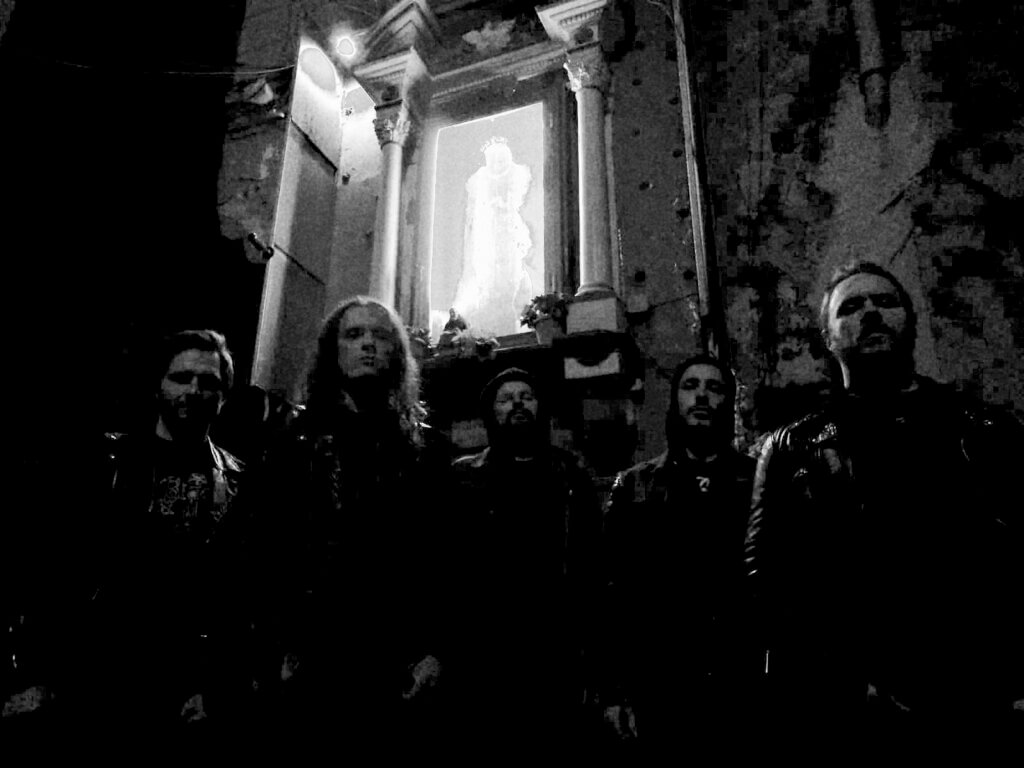 As companion pieces, ‘From the Visceral Abyss’ and ‘Death’ complement each other incredibly well, the latter-mentioned never ceasing to amaze, from ‘Sleeping Throats of the Antichrist’ and ‘Cadaver Synod’ through to ‘Silence of the Great Martyrs’. The song ‘And Darkness Was All’ would fit perfectly on that record actually and indeed the line itself first appears in the lyrics to ‘Sleeping Throats…’, so there appears to be a direct reference back to that point?
“‘And Darkness was All’ was meant to be a tentative title for the album, I found it more ceremonial, however everyone in the band got really used to and liked ‘From the Visceral Abyss’, and I think it was the right choice. On the same song, it directly connects with ‘Strangling Visions’; one is not conceived without the other. The similar twist is used in ‘Death’ for ‘Unearthed Veins’ + ‘Burning in Damnation Fires’, and is not a coincidence.”
The anatomy of the human body and the architecture of manmade structures merge twistedly on ‘From the Visceral Abyss’ as bodily vessels (veins, arteries, nerves) and fluids (blood, bile and urine) seep into stone and clay, and the underground burial chamber lives and breathes. Is the body a temple, or a tomb? Could the design and symmetry of the human body be a fluke or beyond the idea of god is there an architect of all living things?
“You can build your own temple within your body, but just like the sharpest architect cannot control meteorological aspects that would cause an earthquake to crumble its creation apart, there’s an uncertain, uncontrollable aspect of your health that always remains uncertain and random, which may drag you towards the tomb earlier than the average person. There’s a necessary step forward to acknowledge what is beyond our comprehension that keeps us humble, and I think it’s our responsibility to explore and find our ways that nurture that uncertainty.”
Indiscriminate and insatiable, Death is all around us, the irresistible force that will claim every living thing. As the time draws ominously closer, do you fear death, or embrace its inexorable approach?
“Yes.”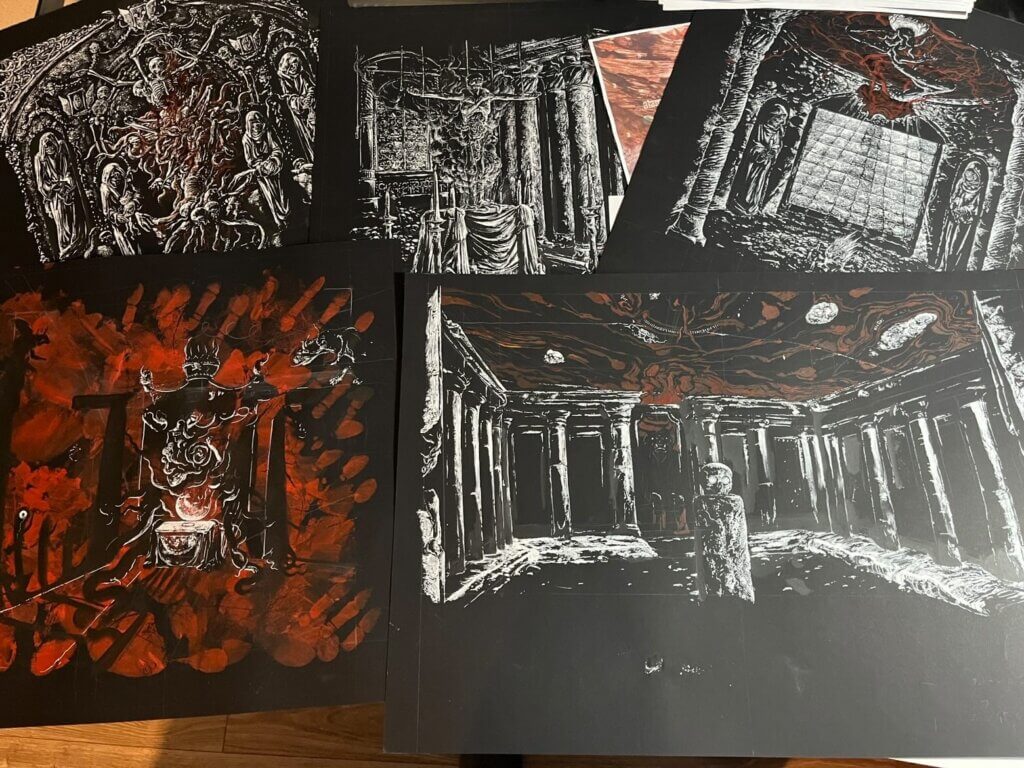 With its myriad drawings, etchings, symbols and inscriptions, the imagery of the fourth full-length is an inebriating orgy of inversion, juxtaposition and anti-geometry, with crimson flourishes and ‘easter eggs’ aplenty referencing prior works (for example, KHEM VEIN TOMB RITE, which featured on the ‘Death’ inlay and ‘The Baneful Choir’ booklet, is reprised). Despite all that’s revealed by absorbing the accompanying booklet, including titles for the intro and outro, much more remains concealed. It’s like unearthing an ancient manuscript or sacred text whose deepest secrets conspire to remain tantalisingly undiscovered amid the maze of inverted, mirrored and backward text / pages / depictions. Can you reveal something hitherto unknown or are you taking all these mysteries with you to the grave?
“All the cryptomancy and hidden sciences that have been present since ‘Seven Chalices’, and in every major release that we have published, are symbols for people to find out or interpret. I’ve always been open to confirming or clarifying specific aspects when people asked me, but as an author I don’t think I should bear the initiative of pointing at specific references, as I tried to explain at the beginning of the interview.”
As well as yourself, Timo, J, Javi and CG, the assembled cast of ‘From the Visceral Abyss’ also features Konstantin, A.V., J. Fiar, Christian and The Anatomist. Can you shed any further light on who these individuals are and / or what roles were assigned to them? Presumably A.V. is Anastasis from Dead Congregation / Nuclear Winter, who perhaps contributed some guitar parts?
“The lowest, cavernous vocals that you can hear in ‘Sepulchral Carrion God’ are Anastasis’ indeed. While some of the guests prefer to remain cryptic, others are rather evident if you scratch a little bit beneath the surface, based on the bands that are closer to us, and also were meaningful to Timo. Their contributions were mostly on some guitar work and also some effects/ambient parts.”