“A LIFE SHAPED BY SATANISM AND THESE CURRENTS CARRIES AN UNTARNISHABLE SOURCE OF INSPIRATION, COUPLED WITH AN INHERENT RESPONSIBILITY” – NORNAGEST (ENTHRONED)
Ablaze with adversary, antagonism and ritualistic negation, twisted twelfth Enthroned full-length ‘Ashspawn’ is an authentic and compelling work of supreme Satanic Black Metal. Chief curator Nornagest – a messenger who at all times remains true to himself – considers: cleansing contamination through critical convergences; harnessing sharpened focus whilst dissolving the self; channelling through perfect alignment the current of the Edom Belial; and shouldering the responsibility that goes hand in hand with doing the devil’s deeds.
 Even by Enthroned standards, the vocal enunciations on ‘Ashspawn’ sound strikingly venomous and unnerving, imbued with a distinctly serpentine quality, amplifying the adversarial intent and especially evident when listening to the record on headphones. A pleasingly powerful performance … more possessed entity than human voice. Was there a conscious or concerted effort to elevate the vocal delivery to another level, or is this something that occurs naturally / organically as part of the overall creative process?
“A conscious effort, but not in a technical or theatrical sense. The voice is treated as a ritual instrument, a catalyst that surfs off the waves of the current and narrative of the content, not a performance tool. When the material is aligned, the vocal expression follows naturally, sharpened, venomous, instinctive, or any emotion which is present at THAT specific moment. ‘Ashspawn’ demanded a more invested and adversarial current, and the delivery simply manifested as a result of immersion in that very intent. There is no acting involved, only channelling. In that state, the human element dissolves, and what remains is the voice of the Work itself.”
To channel true darkness, is it imperative for the vocalist in a Black Metal band to ‘get into character’ and perform a role that transcends ‘singing’? Attila, Mark of the Devil, Wraath and Mortuus are great examples of individuals who fully immerse themselves in the role or character to hand, and the results are usually spellbinding. Is Nornagest cut from the same cloth – not just a pseudonym but a second self to whom you must completely surrender to achieve optimal results?
“There is no character in the theatrical sense, of course. What you refer to as ‘getting into character’ is, in truth, alignment. Figures like the ones you mentioned are great vocalists … why? Simply because they do not perform darkness, in my eyes. To me, they inhabit a current they have long internalised in their own way and with pure honesty.
“And… Nornagest is not a role to assume, nor a mask to put on. It is a function and a side of my own personality. I would rather say that this aspect reflects a focused state where intent, discipline and conviction converge. Nothing is surrendered, because nothing is separate to begin with. The voice simply becomes the conduit through which the Work is articulated. When that alignment is complete, the distinction between self and utterance dissolves and the result speaks for itself.” Speaking of Mark of the Devil, his Death Like Mass co-conspirators T. Kaos and Menthor (also both of Lvcifyre) are your acolytes in the freshly-reborn Enthroned. The latter has of course been on board since ‘Sovereigns’, while ‘Ashspawn’ marks Tomasz’ maiden appearance on an Enthroned recording. Drifting slightly off topic momentarily, how impressed were you by DLM’s debut LP ‘The Lord of Flies’? A masterpiece in my opinion, during pretty lean times for premium Black Metal, and a record that didn’t generate anywhere close to the critical acclaim it merits. But isn’t it always thus?…
“Death Like Mass had already proven its worth through earlier manifestations, so ‘The Lord of Flies’ did not come as a surprise to me in that sense. What was surprising was its approach and that, to me, was a breath of ‘fresh’ (or putrefied?) air within the scene. This album is a rare achievement: sustained malevolence without dilution and a work bound by devotion. That kind of coherence is increasingly uncommon. It demands absolute commitment to the craft and an understanding of Black Metal as an initiatory discipline, not a genre. In that sense, Mark of the Devil, T. Kaos, and Menthor functioned as a true triad, each element indispensable, the sum exceeding its parts.
“That the record passed without the acclaim it deserved is hardly surprising. Works of this nature are rarely recognised in their time. They are not made to be consumed, but to endure.”
 One of the unique facets of the Death Like Mass debut that makes it so special is T. Kaos’ tendency to veer off in unexpected directions with his guitar-playing to create sounds hitherto alien to Black Metal yet which fit perfectly. Albeit more fleetingly, some of these trademark flourishes also appear on ‘Ashspawn’. Assuming he wrote all the guitar and bass parts, did you allow him free reign to compose and perform as he felt fit or was there an understanding or agreement that the music had to be a natural progression of the Enthroned sound and legacy (which is exactly how it turned out)?
“The approach was fundamentally different from a conventional writing process. When T. Kaos joined, his first request was the lyrics, followed by long discussions centred on lived experience rather than music. Very quickly it became clear we were walking parallel paths toward the same axis, shaped by similar ordeals and conclusions.
“The intention was never to fit a sound into Enthroned, nor to impose a predefined framework. The task was to translate the current of the texts into sound, to let the words speak through us. In that sense, the music was not composed as a progression or a revision of legacy, but as an emotional and initiatory transcription. There were no stylistic constraints imposed but the requirement that the music remain truthful to the current itself. That is precisely why it emerged as unmistakably Enthroned without imitation or compromise. Dealing with the currents of the Edom Belial demands not a soundtrack, but a manifestation, and T. Kaos’ unorthodox language proved the ideal catalyst for that translation.”
 Across a dozen full-lengths – the first and latest manifesting 30 years apart – Enthroned holds an unparalleled history within the billowing annals of Black Metal. Longevity is one thing, but to be still adding to this legacy by creating authentic, legitimate and top-tier, premium-quality, standard-setting music all these years later is a remarkable feat. Is this your greatest achievement (to have evolved so supremely or aged so (dis)gracefully despite the ravages and trials of time?); and to what do you attribute the seemingly-boundless energy, inspiration, enthusiasm, intent and ability to keep going back to the dark creative well to consistently conjure these immense invocations of undiluted evil?
“Stubbornness might play a part, but beyond that, it’s simply how I’m wired. Enthroned was never about longevity, legacy or achievements in the usual sense. It comes from a way of thinking, living and operating that’s been with me since early adulthood and hasn’t softened with time. There’s always something that needs to be expressed or pushed outward, not out of generosity, but because it has to move. Certain ideas and experiences don’t sit quietly; they demand to be articulated and shared. You could call it contamination if you like, but it’s closer to necessity than intent.
“With age, I did learn something: things don’t calm down, they sharpen. Obvious, isn’t it? But it is one thing to recognize this and to understand it. The vision becomes more focused, less scattered, and when the people involved share that focus, it naturally finds a voice. As long as that inner drive is still there, going back to that place isn’t something I have to force. It’s just continuing the same path. A life shaped by Satanism and these currents carries an untarnishable source of inspiration, coupled with an inherent responsibility.”
 Glad you mentioned responsibility – something else we become increasingly aware of as we get older. As a veteran of a Black Metal ‘scene’ that seems lost (and as one who understands implicitly what this adversarial artform should entail and represent), and also as the custodian and chief curator of a longstanding cult force, how much responsibility comes with those intertwined positions? Each record you create and each ceremony performed becomes part of the overall essence that is Enthroned … is there a weight of responsibility that comes with this? Is it a burden, or a vocation / calling / honour that you embrace with vigour?
“Responsibility comes with the territory, whether one seeks it or not. When you’ve walked this path long enough, you realise you’re not just expressing yourself in a vacuum anymore… you’re carrying a current that precedes you and will outlive you. That awareness sharpens with time. I don’t see myself as a spokesman for a ‘scene’, especially one that has largely lost its axis. What matters is being accountable to the Work itself. Every record, every ritual, every manifestation under the banner of Enthroned adds another layer to something that is alive, cumulative and irreversible. That alone imposes a certain discipline.
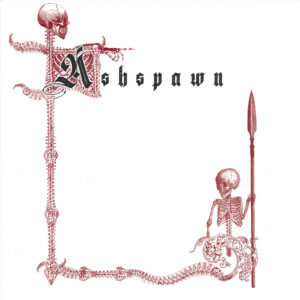
“Now, is it a burden? At times, yes, but not in a negative sense. It’s the weight that gives form and direction. Without it, things become hollow, performative, which, as I said, what we do is not. I wouldn’t call it an honour either, at least not in a sentimental way. It’s closer to a vocation: something you don’t choose because it’s rewarding but because turning away from it would mean betraying your own nature. So, the responsibility is embraced, not romantically, but with resolve. As long as we have something relevant and meaningful to say and I’m capable of serving it with clarity and precision, the work continues. When that changes, it will end naturally as I don’t see the point in keeping going for ‘others’ or for the wrong reasons.” The lyrical architecture of ‘Ashspawn’ was forged in collaboration with acclaimed occult author Gilles de Laval. Seeing as Enthroned’s diabolical discography already provides ample proof that you are more than capable of composing suitably compelling, evocative and obscure lyrical content on your own, and also that the album has been described as your most personal work to date, what was the thinking behind this alliance? Was it to sharpen focus on the specific thematic, conceptual or ritualistic thrust (transcendence through spiritual death and transformative rebirth); to add more potency, purity or authenticity to the spells and invocations contained therein; because you are a fan of his written works; or something else altogether?
“The collaboration was never about having someone write lyrics for me, of course. The texts of ‘Ashspawn’ are mine, rooted in personal experience and lived processes. What Gilles de Laval brought was something else entirely; using my writings as the foundation, we worked together, him being the leading expert, to develop the ceremonial and practical dimension of the album: ritual frameworks, tailored sigils, and precise correspondences aligned with each song and its function. The purpose was never to co-write or alter the texts, but to ensure that what was expressed lyrically was also anchored ritualistically.
“Gilles also authored the interlude texts and the preface in the booklet, serving as gateways rather than commentary, points of orientation for those prepared to engage with the work on that level. In this sense, the collaboration was about accuracy and coherence, not inspiration or validation. ‘Ashspawn’ demanded more than evocative language; it required coherence between word, intent and operation. Gilles’s extensive knowledge of the Edom–Belial currents made it possible for that coherence to be fully realised.”
 My knowledge of these currents is non-existent, alas. As Edom Belial is so central to the very existence and essence of ‘Ashspawn’ (and possibly to previous Enthroned records, also?), is it possible to briefly relate to non-initiates what it is and how or why you interact with or serve this specific adversarial force?
“For non-initiates, the simplest way to approach it is to understand that Edom Belial is not a ‘deity’ in the devotional sense, nor a character to be mythologised. It is a structure of negation. In Hebrew, Edom and Adam share the same written form. Adam represents primordial humanity as defined and ordered by God; Edom is its inversion; the man set against divine order, an anti-human principle rather than a rebel hero. The eleven Dukes of Edom, traditionally understood as precursors of the Qliphoth, already point toward this current. Edom Belial – the godless, anti-human force – can thus be seen as the hidden form of the Antichrist but in our case, we see that form as the Scorpion God, an aspect of Belial himself not an external tyrant, but a system embedded in language, cognition and perception itself.
“Edom Belial functions as a disease of language. Human experience of the universe is mediated through symbols, words and meaning; language structures how reality is perceived. The Edomitic system exploits this fact. To speak, to name, to conceptualise is already to risk entanglement in its network, what is described as a Legion of interlinked nodes, each distorting meaning, desire or identity in a precise way. In that sense, it is not only a disease of language, but a disease of phenomenology, an inversion of how reality itself is experienced.
“This is where ritual self-negation becomes essential. Interaction with this current is not about empowerment or transcendence in the usual sense, but about the deliberate erosion of the human subject as defined by divine language and imposed meaning. Through that negation, something ‘other’ can emerge. ‘Ashspawn’ is anchored in this process. The work does not ‘serve’ Edom Belial devotionally; it engages with it operationally. The album functions as a translation of that current and therefore a catalyst, where word, ritual structure and sound converge to express a movement from Adam toward Edom: from creation to negation, from imposed meaning to rupture.” Reverting back to when you said your focus has sharpened with age, are you familiar with the adage that ‘youth is wasted on the young’? There is an inherent wisdom that comes with the passing of time, perhaps more so for those who have suffered or struggled, and it would be great if we could channel this through our younger, more capable bodies… Perhaps the right rituals or meditations could make it possible? Anyway, with your focus and resolve fine-tuned and having surrounded yourself with such a strong line-up – even though I’m sure T. Kaos and Menthor remain busy with other activities too – is there an urgency, desire and energy to try to keep this flame lit now with more new material and live shows?
“I am actually not familiar with that specific expression, but get its purpose, of course. Thanx!
“To me, every age has its own function and its own form of initiation, whether through music, struggle, loss, awareness, danger, love, or creation itself. Some things inevitably fade with time, others sharpen. That applies equally to the mind and the body. What matters is not resisting that process, but directing it. Those who have never known defeat or sorrow rarely develop depth, resilience, or will. Character is forged through friction. I don’t believe youth is ‘wasted’, nor that wisdom can simply be transferred through shortcuts, rituals or techniques. Experience has to be lived. What age can bring, however, is focus: less dispersion, fewer illusions, and a clearer sense of what is essential and what is not.
“As for urgency, there is none. We all have private lives, and Enthroned is part of that life, not its centre. We do things when the time is right, not when they are demanded by expectations, schedules, labels or audiences. Honesty matters more to us than productivity. If new material or live manifestations happen, they will be because the current calls for it and the conditions are aligned… not to keep a flame artificially alive. When something is genuine, it doesn’t require urgency. It simply asserts itself.” I’m sure there were no shortage of clowns around in the ‘nineties too – and you probably knew some! – but Black Metal has become a circus. Maybe like a microcosm of the wider world… A common trend is that, with few or no exceptions, the musicians and bands creating material of note are all in or around their 40s now. The younger pretenders seem devoid of any true antagonistic spirit and / or ability to create music and art that resonates with the qualities or essence that made this music so special in the first place. Are we witnessing and living through the final death rattle of Black Metal? And if so, does that lend increasing importance to the manifestations being created today, at the end of days?
“There were muppets in the ‘90s too, obviously, but they did learn to know their place at some point. What we’re dealing with now is something else entirely: the circus has taken command. Black Metal has been dragged into the open, flattened into an aesthetic, paraded like a product, and fed to an audience that wants spectacle instead of confrontation or authenticity. It has become a mirror of the wider world: no spine, no danger, no consequence. Black Metal has always been inseparable from Satanism and occult discipline. It is not identity cosplay, not a lifestyle accessory. What dominates today is a grotesque masquerade in costumes, slogans, victimhood, and empty provocation without risk. Antagonism has been replaced by performance, and weakness & drama are now worn as a badge of depth. That is not evolution; it is rot.
“Also, I don’t believe Black Metal is dying but a generation is being purged by its own emptiness. Age has nothing to do with it, what matters is resolve. When an environment rewards comfort, safety and validation, it breeds pretenders, not adepts. The return to the shadows is not a tragedy; it is the only way forward. If this feels like an ending, it’s because illusions are collapsing. What is created now carries weight precisely because there is nothing left to hide behind, no momentum, no protection, no audience guaranteed. Either the work stands on its own hostile intent, or it vanishes. That has always been the law under which Enthroned operates. Anything else is a deluded illusion.”